Corporate America Is All-In on AI
A chatbot with uncanny human-like abilities became the poster child for generative artificial intelligence (gen AI) when it was released to the public in late 2022, inspiring new levels of attention, excitement, and concern.

Corporate spending on gen AI by businesses worldwide is expected to increase from $61.9 billion in 2025 to more than $202 billion in 2028, as executives aim to keep up with competitors, unleash cost savings, and improve profit margins down the road. Total global investment in AI solutions (including AI-enabled applications, infrastructure, and related IT and business services) is forecast to hit $307 billion in 2025, and then more than double to $632 billion by 2028.1
As the race among large tech companies to monetize AI hits full throttle, it’s worth considering how rapid adoption of AI-enabled technologies might affect the economic prospects of businesses and workers.
How AI changes the game
Artificial intelligence uses algorithms to sort through data to detect and react to patterns, which allows it to “learn” from experience. As AI has advanced and joined robots, sensors, and other technologies, many tasks have already been automated in ways that were once unimaginable. Smartphone apps connect drivers to people who need a ride, and in some cities, driverless cars are already navigating the roads.
Generative AI is powered by large language models, which are deep learning algorithms trained with immense datasets to recognize, summarize, translate, and generate text. These models can create original content in response to questions posed by users. A recent survey found that one in five U.S. workers regularly uses AI for tasks such as writing essays, articles, and business communications, coding software, conducting research, creating lesson plans, analyzing sales reports, crafting works of art such as illustrations, graphic designs, and music — and more.2
A known flaw of gen AI systems is that they sometimes “hallucinate,” or make up facts, when they can’t find enough relevant data to inform a reasonable response. However, performance may improve as software is “trained” over time.3
Higher productivity with fewer workers
Advances in technology and automation have been displacing workers for a long time, but the wide-ranging capabilities of AI suggest that many more human jobs — including those for skilled and highly educated professionals — could be eliminated. When researchers used AI-powered models to assess the potential effects of generative AI on the workforce, they concluded that 80% of human workers would have at least 10% of their tasks affected, and 19% would have more than half of their tasks affected, which puts them at greater risk of being replaced.4 The long list of occupations that are most exposed to AI includes many types of knowledge workers, such as postsecondary teachers, analysts, lawyers, mathematicians, accountants, human resources specialists, sales representatives, journalists, and other communications professionals.5
Is AI Upending the Workforce Already?
College graduates looking to join the workforce in 2025 encountered the most discouraging labor market in recent memory. By one estimate, 85% of the increase in the U.S. unemployment rate since mid-2023 is concentrated in new grads who can’t find entry-level jobs. While some of this rise is due to normalization after a post-pandemic surge in hiring and uncertainty around tariffs, there are signs that AI is replacing entry-level workers at higher rates.
U.S. unemployment rate, three-month moving average
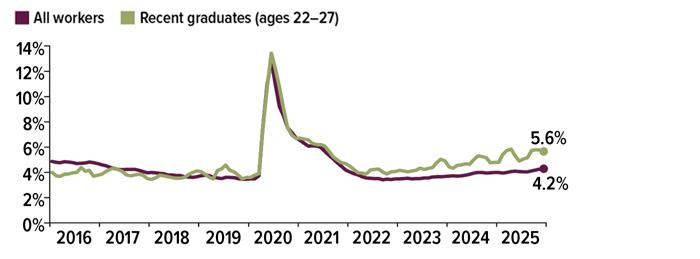
Sources: Bloomberg Businessweek, June 9, 2025; Federal Reserve, 2026
It’s been estimated that gen AI could complement two-thirds of jobs by helping workers complete tasks in less time, which suggests employers may need fewer workers in the future. By 2032, AI adoption could boost labor productivity by about 1.5% per year in the United States (to roughly double the current rate) and 1.4% globally. Productivity, or output per hour of work, is a good indicator of society’s overall prosperity and economic well-being. A surge in productivity of this magnitude would also improve employers’ profit margins and raise the world’s gross domestic product by 7% — or about $7 trillion.6
On the other hand, if rapid deployment of AI forces too many displaced workers into lower-paying jobs or out of the workforce completely, it could lead to a downward spiral of reduced consumer spending that stifles economic growth. It might also spur social unrest.
Either way, today’s workers may need to learn new skills more often — and be capable of adapting to change more quickly — than previous generations.